Premium Phosphosite-Specific 7TM Antibodies
Your Resource for GPCR Research
Select Your Country of Delivery below

5-HT4 Receptor Antibodies
Close filters
No results were found for the filter!
NEW
pT343/pS347/pT348-5-HT4 (phospho-5-HT Receptor 4 Antibody)
pT343/pS347/pT348-5-HT4 (phospho-5-HT Receptor...
Threonine343/Serine347/Threonine348 is a major phosphorylation site of the 5-HT4 receptor. The pT343/pS347/pT348-5-HT4 antibody detects phosphorylation in response to high-efficacy agonists but not after PKC activation. T343/S347/T348...
£ 335.00 *
NEW
Agonist-induced Serine354/Threonine355 phosphorylation of the 5-Hydroxytryptamine Receptor 4
pS354/pT355-5-HT4 (phospho-5-HT Receptor 4...
Serine354/Threonine355 is a major phosphorylation site of the 5-HT4 receptor. The pS354/pT355-5-HT4 antibody detects phosphorylation in response to high-efficacy agonists but not after PKC activation. S354/T355 phosphorylation is a key...
£ 335.00 *
NEW
Immunohistochemical identification of 5-Hydroxytryptamine Receptor 4 in kidney
5-HT4 (IHC-grade), 5-HT Receptor 4 Antibody
The 5-HT4 receptor antibody is directed against the distal part of the carboxyl-terminal tail of human 5-Hydroxytryptamine Receptor 4 (5-HT4). It can be used to detect total 5-HT4 receptors in Western blots independent of...
£ 335.00 *

5HT4

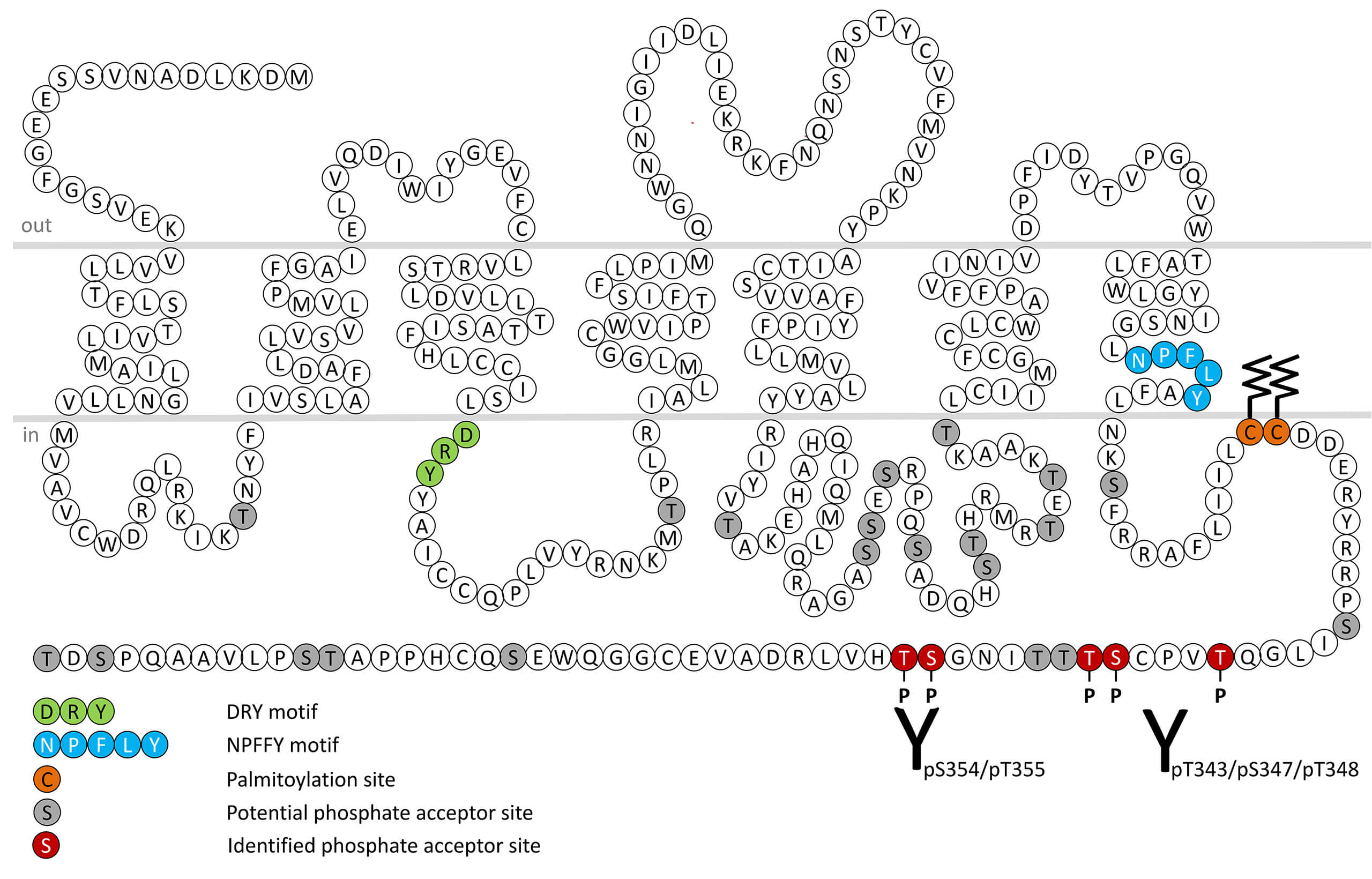
The 5-HT4 receptor is a G protein-coupled receptor (GPCR) that mediates the effects of serotonin (5-hydroxytryptamine, 5-HT) and plays important roles in gastrointestinal motility, cardiac function, and central nervous system signaling. Expression of the 5-HT4 receptor is highest in the gastrointestinal tract, brain, and heart and is regulated by tissue-specific transcriptional mechanisms, developmental cues, and physiological stimuli. Upon activation, the receptor primarily couples to Gs proteins, stimulating adenylyl cyclase activity and increasing intracellular cyclic AMP (cAMP) levels, which subsequently activate protein kinase A-dependent signaling pathways. Alternative splicing generates multiple receptor isoforms with distinct tissue distributions and regulatory properties. The 5-HT4 receptor promotes acetylcholine release in the enteric nervous system, enhances gastrointestinal motility, and contributes to learning, memory, and neuroprotection in the brain. Receptor activity is further controlled by ligand-induced desensitization, phosphorylation, and internalization following prolonged stimulation. Several clinically approved drugs target the 5-HT4 receptor, including prucalopride for chronic idiopathic constipation and mosapride and tegaserod in selected regions or indications, although some earlier agonists were withdrawn or restricted because of cardiovascular safety concerns. The 5-HT4 receptor is a GPCR that couples via Gs to increase cAMP production. The structure displays less than 34% amino acid sequence identity to other 5-HT GPCRs. Selective agonists (RS67506) and antagonists (SB204070) are available. 5-HT4 receptor desensitization, β-arrestin recruitment and internalization are regulated by phosphorylation of carboxyl-terminal threonine343/serine347/threonine348 (pT343/pS347/pT348-5-HT4) and serine354/threonine355 (pS354/pT355-5-HT4) residues. This nomenclature refers to the human 5-HT4. For more information on 5-HT4 pharmacology please refer to the IUPHAR database. For further reading refer to:

Hoyer D, Clarke DE, Fozard JR, Hartig PR, Martin GR, Mylecharane EJ, Saxena PR, Humphrey PP. International Union of Pharmacology classification of receptors for 5-hydroxytryptamine (Serotonin). Pharmacol Rev. 1994 Jun;46(2):157-203. PMID: 7938165.

Barnes NM, Ahern GP, Becamel C, Bockaert J, Camilleri M, Chaumont-Dubel S, Claeysen S, Cunningham KA, Fone KC, Gershon M, Di Giovanni G, Goodfellow NM, Halberstadt AL, Hartley RM, Hassaine G, Herrick-Davis K, Hovius R, Lacivita E, Lambe EK, Leopoldo M, Levy FO, Lummis SCR, Marin P, Maroteaux L, McCreary AC, Nelson DL, Neumaier JF, Newman-Tancredi A, Nury H, Roberts A, Roth BL, Roumier A, Sanger GJ, Teitler M, Sharp T, Villalón CM, Vogel H, Watts SW, Hoyer D. International Union of Basic and Clinical Pharmacology. CX. Classification of Receptors for 5-hydroxytryptamine; Pharmacology and Function. Pharmacol Rev. 2021 Jan;73(1):310-520. doi: 10.1124/pr.118.015552. PMID: 33370241; PMCID: PMC7770494.

Bockaert J, Claeysen S, Compan V, Dumuis A. 5-HT(4) receptors, a place in the sun: act two. Curr Opin Pharmacol. 2011 Feb;11(1):87-93. doi: 10.1016/j.coph.2011.01.012. Epub 2011 Feb 20. PMID: 21342787.


The 5-HT4 receptor is a G protein-coupled receptor (GPCR) that mediates the effects of serotonin (5-hydroxytryptamine, 5-HT) and plays important roles in gastrointestinal motility, cardiac... read more »
Close window
5-HT4 Receptor Antibodies

5HT4

The 5-HT4 receptor is a G protein-coupled receptor (GPCR) that mediates the effects of serotonin (5-hydroxytryptamine, 5-HT) and plays important roles in gastrointestinal motility, cardiac function, and central nervous system signaling. Expression of the 5-HT4 receptor is highest in the gastrointestinal tract, brain, and heart and is regulated by tissue-specific transcriptional mechanisms, developmental cues, and physiological stimuli. Upon activation, the receptor primarily couples to Gs proteins, stimulating adenylyl cyclase activity and increasing intracellular cyclic AMP (cAMP) levels, which subsequently activate protein kinase A-dependent signaling pathways. Alternative splicing generates multiple receptor isoforms with distinct tissue distributions and regulatory properties. The 5-HT4 receptor promotes acetylcholine release in the enteric nervous system, enhances gastrointestinal motility, and contributes to learning, memory, and neuroprotection in the brain. Receptor activity is further controlled by ligand-induced desensitization, phosphorylation, and internalization following prolonged stimulation. Several clinically approved drugs target the 5-HT4 receptor, including prucalopride for chronic idiopathic constipation and mosapride and tegaserod in selected regions or indications, although some earlier agonists were withdrawn or restricted because of cardiovascular safety concerns. The 5-HT4 receptor is a GPCR that couples via Gs to increase cAMP production. The structure displays less than 34% amino acid sequence identity to other 5-HT GPCRs. Selective agonists (RS67506) and antagonists (SB204070) are available. 5-HT4 receptor desensitization, β-arrestin recruitment and internalization are regulated by phosphorylation of carboxyl-terminal threonine343/serine347/threonine348 (pT343/pS347/pT348-5-HT4) and serine354/threonine355 (pS354/pT355-5-HT4) residues. This nomenclature refers to the human 5-HT4. For more information on 5-HT4 pharmacology please refer to the IUPHAR database. For further reading refer to:

Hoyer D, Clarke DE, Fozard JR, Hartig PR, Martin GR, Mylecharane EJ, Saxena PR, Humphrey PP. International Union of Pharmacology classification of receptors for 5-hydroxytryptamine (Serotonin). Pharmacol Rev. 1994 Jun;46(2):157-203. PMID: 7938165.

Barnes NM, Ahern GP, Becamel C, Bockaert J, Camilleri M, Chaumont-Dubel S, Claeysen S, Cunningham KA, Fone KC, Gershon M, Di Giovanni G, Goodfellow NM, Halberstadt AL, Hartley RM, Hassaine G, Herrick-Davis K, Hovius R, Lacivita E, Lambe EK, Leopoldo M, Levy FO, Lummis SCR, Marin P, Maroteaux L, McCreary AC, Nelson DL, Neumaier JF, Newman-Tancredi A, Nury H, Roberts A, Roth BL, Roumier A, Sanger GJ, Teitler M, Sharp T, Villalón CM, Vogel H, Watts SW, Hoyer D. International Union of Basic and Clinical Pharmacology. CX. Classification of Receptors for 5-hydroxytryptamine; Pharmacology and Function. Pharmacol Rev. 2021 Jan;73(1):310-520. doi: 10.1124/pr.118.015552. PMID: 33370241; PMCID: PMC7770494.

Bockaert J, Claeysen S, Compan V, Dumuis A. 5-HT(4) receptors, a place in the sun: act two. Curr Opin Pharmacol. 2011 Feb;11(1):87-93. doi: 10.1016/j.coph.2011.01.012. Epub 2011 Feb 20. PMID: 21342787.

Recently viewed