

Premium Phosphosite-Specific 7TM Antibodies
Your Resource for GPCR Research
Select Your Country of Delivery below

Sphingosine 1-Phosphate Receptor 5 Antibodies

Close filters
No results were found for the filter!
NEW
 Agonist-induced Serine347 phosphorylation of the mouse Sphingosine 1-Phosphate Receptor 5
pS347-mS1P5 (phospho-mouse-Sphingosine...
Serine347 (S347) is major phosphorylation site of the mouse Sphingosine 1-Phosphate Receptor 5 (S1P5). The pS347-mS1P5 antibody detects phosphorylation in response to agonists. S347 phosphorylation is likely to be involved in efficient...
£ 335.00 *
NEW
Agonist-induced Serine362/Serine363/Serine364 phosphorylation of the mouse Sphingosine 1-Phosphate Receptor 5
pS362/pS363/pS364-mS1P5...
Serine362/Serine363/Serine364 (S362/S363/S364) is major phosphorylation site of the mouse Sphingosine 1-Phosphate Receptor 5 (mS1P5). The pS362/pS363/pS364-mS1P5 antibody detects phosphorylation in response to agonists. S362/S363/S364...
£ 335.00 *
NEW
Agonist-induced Serine345 phosphorylation of the Sphingosine 1-Phosphate Receptor 5
pS345-S1P5 (phospho-Sphingosine 1-Phosphate...
Serine345 (S345) is major phosphorylation site of the Sphingosine 1-Phosphate Receptor 5 (S1P5). The pS345-S1P5 antibody detects phosphorylation in response to agonists. S345 phosphorylation is likely to be involved in efficient ligand...
£ 335.00 *
NEW
Agonist-induced Serine359/Serine361/Serine363 phosphorylation of the Sphingosine 1-Phosphate Receptor 5
pS359/pS361/pS363-S1P5 (phospho-Sphingosine...
Serine359/Serine361/Serine363 (S359/S361/S363) is major phosphorylation site of the Sphingosine 1-Phosphate Receptor 5 (S1P5). The pS359/pS361/pS363-S1P5 antibody detects phosphorylation in response to agonists. S359/S361/S363...
£ 335.00 *
NEW
Agonist-induced Serine366/Serine367 phosphorylation of the Sphingosine 1-Phosphate Receptor 5
pS366/pS367-S1P5 (phospho-Sphingosine...
Serine366/Ser367 (S366/S367) is major phosphorylation site of the Sphingosine 1-Phosphate Receptor 5 (S1P5). The pS366/pS367-S1P5 antibody detects phosphorylation in response to agonists. S366/S367 phosphorylation is likely to be...
£ 335.00 *
NEW
Validation of the mouse S1P5 Receptor in transfected HEK293 cells
mS1P5 (non-phospho), Mouse Sphingosine...
The non-phospho-mS1P5 receptor antibody is directed against the distal end of the carboxyl-terminal tail of mouseS1P5. It can be used to detect total mS1P5 receptors in Western blots independent of phosphorylation. The mS1P5 antibody can...
£ 335.00 *
NEW
Validation of the mouse S1P5 Receptor in transfected HEK293 cells
mS1P5 (GP-non-phospho), Mouse Sphingosine...
The non-phospho-mS1P5 receptor antibody is directed against the distal end of the carboxyl-terminal tail of mouseS1P5. It can be used to detect total mS1P5 receptors in Western blots independent of phosphorylation. The mS1P5 antibody can...
£ 335.00 *
NEW
Validation of the S1P5 Receptor in transfected HEK293 cells.
S1P5 (non-phospho), Sphingosine 1-Phosphate...
The non-phospho-S1P5 receptor antibody is directed against the distal end of the carboxyl-terminal tail of human S1P5. It can be used to detect total S1P5 receptors in Western blots independent of phosphorylation. The S1P5 antibody can...
£ 335.00 *
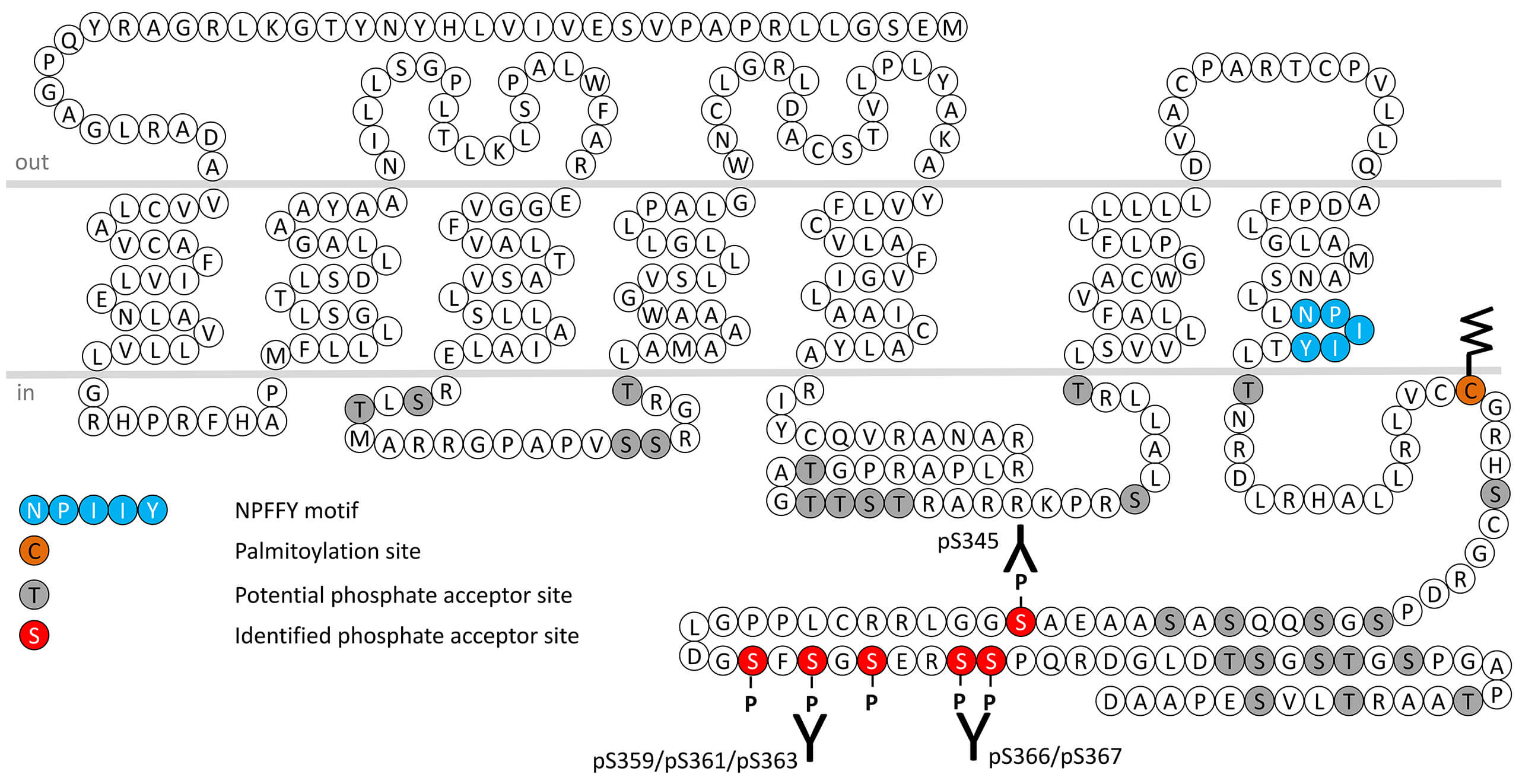
The sphingosine-1-phosphate receptor 5 (S1P5 receptor) is a G protein-coupled receptor (GPCR) that mediates the actions of sphingosine-1-phosphate (S1P), a bioactive lipid involved in immune regulation and central nervous system function. S1P5 receptor expression is highly enriched in oligodendrocytes within the central nervous system and is also found in natural killer cells and certain other immune cell populations, where its expression is regulated by developmental and tissue-specific transcriptional programs. Upon activation, the receptor primarily couples to Gi and G12/13 proteins, leading to inhibition of adenylyl cyclase, activation of Rho signaling, and modulation of cell survival and migration pathways. S1P5 signaling plays an important role in oligodendrocyte differentiation, myelin maintenance, and natural killer cell trafficking. Receptor activity is regulated by ligand availability, receptor internalization, and desensitization mechanisms following sustained stimulation. Dysregulated S1P5 signaling has been implicated in neuroinflammatory and demyelinating disorders, including multiple sclerosis. Several approved S1P receptor modulators, such as ozanimod and siponimod, exhibit activity at S1P5 in addition to other S1P receptor subtypes, whereas no highly selective S1P5-specific drug has yet been approved for clinical use. S1P5 receptors are expressed in brain, spleen, peripheral blood leukocytes, placenta, lung and aorta. In the immune system S1P5 receptors regulate immune cell trafficking and mitogenesis, are involved in immune-modulation, and suppression of innate immune T cell responses. S1P5 is also a target for second-generation S1P receptor modulators siponimod, ozanimod, and ponesimod that target both S1P1 and S1P5 which are FDA-approved for the treatment of various MS forms. S1P5 receptors are regulated by phosphorylation of carboxyl-terminal serine345 (pS345-S1P5), serine359/serine361/serine363 (pS359/pS361/pS363-S1P5) and serine366/serine367 (pS366/pS367-S1P5). This nomenclature refers to the human S1P5 receptor. For more information on S1P5 pharmacology please refer to the IUPHAR database. For further reading refer to:

Chun J, Hla T, Lynch KR, Spiegel S, Moolenaar WH. International Union of Basic and Clinical Pharmacology. LXXVIII. Lysophospholipid receptor nomenclature. Pharmacol Rev. 2010 Dec;62(4):579-87. doi: 10.1124/pr.110.003111. PMID: 21079037; PMCID: PMC2993255.

Kihara Y, Maceyka M, Spiegel S, Chun J. Lysophospholipid receptor nomenclature review: IUPHAR Review 8. Br J Pharmacol. 2014 Aug;171(15):3575-94. doi: 10.1111/bph.12678. Epub 2014 Jul 12. PMID: 24602016; PMCID: PMC4128058.

Blaho V, Chun J, Herr D, Jones D, Jonnalagadda D, Kihara Y. Lysophospholipid (S1P) receptors in GtoPdb v.2023.1. IUPHAR/BPS Guide to Pharmacology CITE. 2023; 2023(1).

The sphingosine-1-phosphate receptor 5 (S1P5 receptor) is a G protein-coupled receptor (GPCR) that mediates the actions of sphingosine-1-phosphate (S1P), a bioactive lipid involved in immune... read more »
Close window
Sphingosine 1-Phosphate Receptor 5 Antibodies

The sphingosine-1-phosphate receptor 5 (S1P5 receptor) is a G protein-coupled receptor (GPCR) that mediates the actions of sphingosine-1-phosphate (S1P), a bioactive lipid involved in immune regulation and central nervous system function. S1P5 receptor expression is highly enriched in oligodendrocytes within the central nervous system and is also found in natural killer cells and certain other immune cell populations, where its expression is regulated by developmental and tissue-specific transcriptional programs. Upon activation, the receptor primarily couples to Gi and G12/13 proteins, leading to inhibition of adenylyl cyclase, activation of Rho signaling, and modulation of cell survival and migration pathways. S1P5 signaling plays an important role in oligodendrocyte differentiation, myelin maintenance, and natural killer cell trafficking. Receptor activity is regulated by ligand availability, receptor internalization, and desensitization mechanisms following sustained stimulation. Dysregulated S1P5 signaling has been implicated in neuroinflammatory and demyelinating disorders, including multiple sclerosis. Several approved S1P receptor modulators, such as ozanimod and siponimod, exhibit activity at S1P5 in addition to other S1P receptor subtypes, whereas no highly selective S1P5-specific drug has yet been approved for clinical use. S1P5 receptors are expressed in brain, spleen, peripheral blood leukocytes, placenta, lung and aorta. In the immune system S1P5 receptors regulate immune cell trafficking and mitogenesis, are involved in immune-modulation, and suppression of innate immune T cell responses. S1P5 is also a target for second-generation S1P receptor modulators siponimod, ozanimod, and ponesimod that target both S1P1 and S1P5 which are FDA-approved for the treatment of various MS forms. S1P5 receptors are regulated by phosphorylation of carboxyl-terminal serine345 (pS345-S1P5), serine359/serine361/serine363 (pS359/pS361/pS363-S1P5) and serine366/serine367 (pS366/pS367-S1P5). This nomenclature refers to the human S1P5 receptor. For more information on S1P5 pharmacology please refer to the IUPHAR database. For further reading refer to:

Chun J, Hla T, Lynch KR, Spiegel S, Moolenaar WH. International Union of Basic and Clinical Pharmacology. LXXVIII. Lysophospholipid receptor nomenclature. Pharmacol Rev. 2010 Dec;62(4):579-87. doi: 10.1124/pr.110.003111. PMID: 21079037; PMCID: PMC2993255.

Kihara Y, Maceyka M, Spiegel S, Chun J. Lysophospholipid receptor nomenclature review: IUPHAR Review 8. Br J Pharmacol. 2014 Aug;171(15):3575-94. doi: 10.1111/bph.12678. Epub 2014 Jul 12. PMID: 24602016; PMCID: PMC4128058.

Blaho V, Chun J, Herr D, Jones D, Jonnalagadda D, Kihara Y. Lysophospholipid (S1P) receptors in GtoPdb v.2023.1. IUPHAR/BPS Guide to Pharmacology CITE. 2023; 2023(1).

Recently viewed